



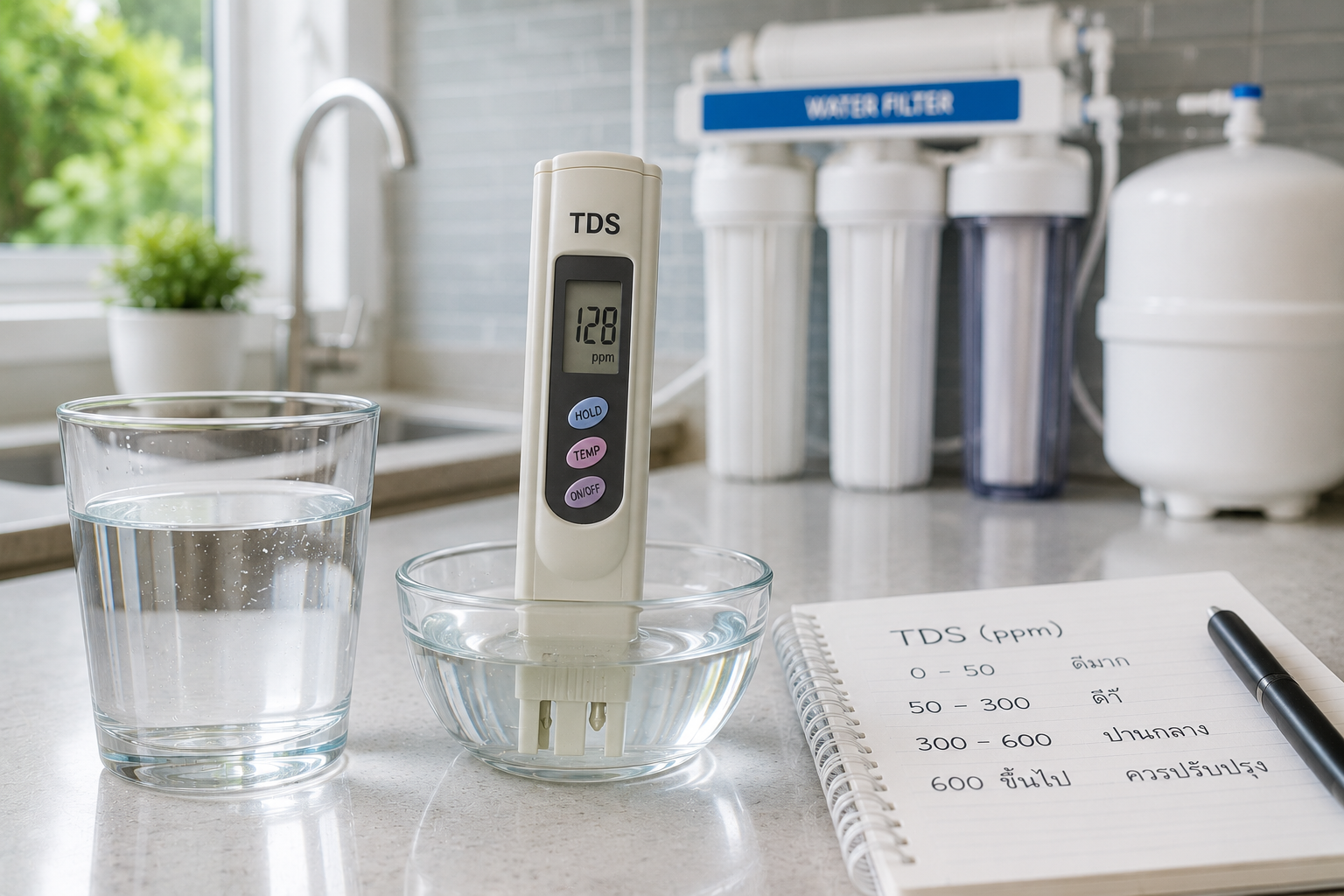
Many homeowners who start learning about water quality may have heard the term “TDS” or used a TDS meter to test water. The meter may show numbers such as 30, 120, 300, or 600 ppm, but it is not always clear what these numbers mean or how much they should influence water filter selection.
TDS stands for Total Dissolved Solids. It refers to the total amount of dissolved substances in water, such as minerals, salts, calcium, magnesium, sodium, chloride, sulfate, and other dissolved compounds that cannot be seen with the naked eye. TDS is usually measured in ppm or mg/L.
What Does TDS Tell Us?
TDS gives a general idea of how much dissolved material is present in water. Low TDS water may taste light or flat, while high TDS water may taste mineral-like, salty, bitter, or unpleasant depending on what substances are dissolved in it.
However, TDS alone does not prove that water is safe or unsafe. A TDS meter cannot identify what the dissolved substances are. The reading may come from common minerals, or it may indicate other dissolved contaminants. Therefore, TDS should be used only as a basic indicator together with other water quality observations.
Does High TDS Always Mean Dirty Water?
No. Some mineral waters naturally have higher TDS because they contain more dissolved minerals. This does not automatically mean the water is dirty. On the other hand, very low TDS does not always mean the water is completely safe, because some contaminants may not be clearly reflected in a TDS reading.
To understand water quality properly, other factors should also be considered, such as turbidity, color, odor, taste, pH, hardness, chlorine, iron, manganese, bacteria, and specific contaminants.
How Does TDS Affect Water Taste?
Water with very low TDS may taste flat or empty. Water with higher TDS may have a stronger mineral taste or a slightly salty or bitter flavor. The actual taste depends on the type of dissolved substances in the water.
High TDS may also contribute to scale buildup or white stains in kettles, coffee machines, ice makers, faucets, and bathroom fixtures.
Are Drinking Water and Household Water Standards the Same?
No. Drinking water and household water should not be judged by exactly the same standard because they are used for different purposes.
Drinking Water
Drinking water should meet a higher standard because it is consumed directly. It should be evaluated not only by TDS, but also by safety, taste, microorganisms, chemicals, and other contaminants.
Common drinking water systems include RO, UF, UV, carbon filters, and multi-stage filtration systems depending on the source water and household needs.
Household Water
Household water is used for bathing, laundry, dishwashing, cleaning, water heaters, washing machines, and plumbing systems. The key concerns are sediment, rust, odor, color, hardness, and the effect on appliances and pipes.
For household water, TDS may be higher than drinking water as long as the water does not cause serious staining, odor, sediment buildup, or damage to appliances.
What TDS Level Is Suitable?
There is no single ideal TDS number for every home. The suitable range depends on the water source and intended use. The following table can be used as a general guide.
| Approximate TDS | General meaning | Notes |
|---|---|---|
| 0–50 ppm | Very low | Often found in RO water; may taste very flat |
| 50–300 ppm | Generally suitable for drinking water | Usually easy to drink, depending on minerals present |
| 300–600 ppm | Moderate | May be acceptable, but taste and scale should be observed |
| Above 600 ppm | Relatively high | Further water quality assessment is recommended |
How Should a TDS Meter Be Used?
A TDS meter is useful for basic comparison, such as checking water before and after filtration or monitoring changes over time. However, it should not be used as the only tool to decide whether water is safe to drink.
For example, if drinking water from a filter used to measure 40 ppm but later measures 150 ppm, it may indicate that the filter performance has changed or that maintenance is needed. Still, odor, taste, filter age, and other water quality factors should also be checked.
Should You Choose a Water Filter Based Only on TDS?
No. Water problems vary from one home to another. A home with sediment or rust needs sediment filtration. A home with strong chlorine odor may need carbon filtration. A home that requires high-quality drinking water may need RO or multi-stage filtration. A home with scale buildup may need hardness testing.
The right filtration system should be selected based on the source water, actual problems, usage points, and budget — not only on the TDS number.
Conclusion
TDS measures the total amount of dissolved solids in water. It is useful as a basic indicator, but it does not represent the complete safety or quality of water.
Drinking water should be assessed more strictly because it is consumed directly, while household water should focus on sediment, odor, rust, color, hardness, and the impact on appliances and plumbing.
Pavie 1979 provides consultation for whole-house water filtration, drinking water systems, and basic water quality assessment for homes, cafés, and small businesses in Plaeng Yao, Bang Khla, Chachoengsao, and nearby areas. You can send your TDS reading, water photos, or water problems for preliminary system recommendations.