


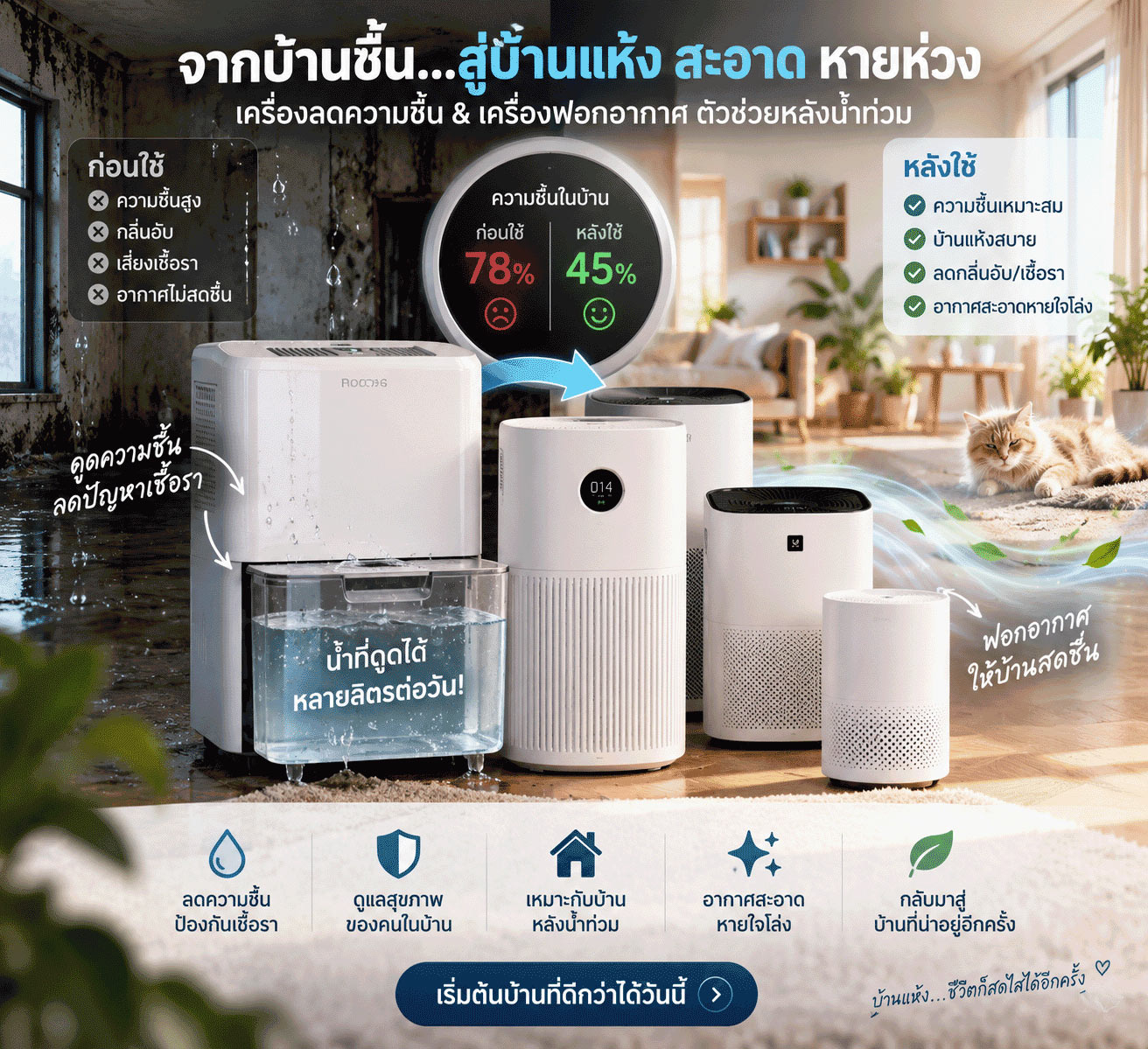
Visible floodwater may have disappeared, but moisture does not disappear at the same time. Floors, walls, furniture, cabinets and other materials can continue releasing moisture into indoor air, leaving a home damp, slow to dry and more favorable to mold growth.
Dehumidifier vs. air purifier
| Equipment | Main job | Useful when | What it does not do |
|---|---|---|---|
| Dehumidifier | Removes water vapor and collects it as water | The home is still damp or musty | Does not replace cleanup or removal of damaged materials |
| Air purifier | Filters airborne particles | During cleanup and after the space begins to dry | Does not pull moisture out of walls |
| 2-in-1 | Dehumidifies and filters air | Both functions are wanted in one unit | L/day and CADR must still be evaluated separately |
If the home is still very damp, dehumidification should generally be addressed before relying on an air purifier for airborne particles.
Why L/day matters more than tank size
13, 22 or 30 L/day describes moisture-removal capacity under specified test conditions, not tank size. Test conditions can differ. Xiaomi specifies 22 L/day at 26.7°C/60% RH; Sharp specifies 30 L/day at 30°C/80% RH and also documents 18.5 L/day at 26.7°C/60% RH. Headline figures should not be compared without checking conditions.
| Space or condition | Capacity to start considering | Notes |
|---|---|---|
| 10-15 m², normal humidity | 10-13 L/day | Small enclosed room |
| 15-25 m² | 13-20 L/day | Allow extra capacity after flooding |
| 20-40 m², high humidity | 20-25 L/day | Continuous drainage is useful |
| 40 m²+ | 25-30 L/day+ | Consider zoning or multiple units |
| Recently flooded | More than normal use | Monitor RH and the drying trend |
Dehumidifier comparison
1. Xiaomi Smart Dehumidifier Lite 13L / Smart Dehumidifier 22L
View Xiaomi Smart Dehumidifier
Variant warning: The listing may contain multiple models. Select 13L or 22L before ordering.
Lite: 13 L/day at 30°C/80% RH, airflow 140 m³/h. The 22L model: 22 L/day at 26.7°C/60% RH, airflow 185 m³/h, 4.5 L tank, 380 W rated input and no more than 41 dB(A).
Suitable for: 13L for smaller rooms or routine humidity control; 22L for higher capacity and smart controls.
2. Electrolux UltimateHome 300 EDH10TRBW1
Source data: 42 m², 173 W, 33-38 dB; 10 L/day at 26.7°C/60% RH and 20 L/day at 30°C/80% RH.
Suitable for: Medium rooms and users wanting manufacturer-stated room coverage.
3. Sharp DW-T30FB
30 L/day at 30°C/80% RH; 18.5 L/day at 26.7°C/60% RH; 39-77 m² dehumidification coverage; approximately 4.5 L tank; continuous drainage. Purification mode uses a pre-filter, HEPA and carbon, with 37 m² coverage and CADR 290 m³/h in the source data.
Suitable for: Larger or high-humidity spaces and users wanting dehumidification plus filtration.
4. Philips Series 5000 DE5305/11
Source data: up to 26.5 L/day dehumidification, CADR 270 m³/h, NanoProtect HEPA and a 4 L tank.
Suitable for: Homes wanting both functions in one appliance.
Air purifiers after a flood
An air purifier does not replace a dehumidifier. It can help reduce airborne particles during cleanup and after drying begins. Visible mold or affected materials still require source control and appropriate remediation.
| Model | CADR or airflow | Reference area | Key point |
|---|---|---|---|
| Xiaomi Smart Air Purifier 4 Compact | 230 m³/h | 16-27 m² | Compact |
| Xiaomi Smart Air Purifier 4 | 400 m³/h | 28-48 m² | Higher CADR |
| Sharp FP-J30TA | Maximum airflow 180 m³/h | 23 m² | HEPA and Plasmacluster 7000 |
| Philips AC0950/10 | 250 m³/h | Up to 65 m² per Philips | HEPA, activated carbon and PM2.5 sensor |
5. Xiaomi Smart Air Purifier 4 Compact
View Xiaomi Air Purifier 4 Compact
Particle CADR 230 m³/h, effective coverage 16-27 m², approximately 2.2 kg.
Suitable for: Small rooms or bedrooms that have begun to dry.
6. Xiaomi Smart Air Purifier 4
PM CADR 400 m³/h, effective coverage 28-48 m². Source data includes Xiaomi's example of about one air circulation every 10 minutes in a 20 m² room with a 3 m ceiling at maximum airflow.
Suitable for: Medium-to-large rooms.
7. Sharp FP-J30TA
23 m² purification coverage, 16 m² high-density Plasmacluster coverage, HEPA, maximum airflow 180 m³/h and 23-44 dB.
Suitable for: Small-to-medium rooms.
8. Philips PureProtect Mini 900 Series AC0950/10
CADR 250 m³/h, coverage up to 65 m² according to source data, HEPA, activated carbon and PM2.5 sensor.
Suitable for: Users wanting a compact purifier with particle sensing.
If you can buy only one appliance first
- Still damp or substantial water is being collected: dehumidifier first.
- Drying is underway but cleanup creates dust and particles: an air purifier becomes useful.
- Need both functions in limited space: consider a 2-in-1 while evaluating each function separately.
- Large area: consider zoning rather than relying only on advertised square meters.
Post-flood dehumidifier use
- Confirm electrical safety.
- Remove standing water, mud and severely damaged wet materials.
- Clean appropriately.
- Divide the home into zones and close the safe zone being dehumidified.
- Improve air circulation without spreading contamination.
- Follow clearance instructions.
- Use continuous drainage for extended operation when available.
- Track RH.
- A dry-looking surface may still contain moisture.
- For extensive mold, structural damage or heavily saturated materials, consider professional remediation.
FAQ
Does an air purifier dry a flooded home?
No. It filters airborne particles; it does not remove moisture from building materials.
Does "20L" mean a 20-liter tank?
No. L/day normally describes moisture-removal capacity under specified test conditions.
Why isn't 30L automatically 50% stronger than 20L?
Test temperature and RH may differ.
How many days should a dehumidifier run?
There is no universal number; monitor RH, the drying trend, collected water and materials.
Air purifier or dehumidifier first?
If residual moisture is the main problem, start with dehumidification.